
Wonju Personal Rehabilitation: Responding to Correction Requests, Supporting Documents and the Liquidation Value Standard
Personal rehabilitation in Wonju does not end with submitting the application; how well you respond to the court's correction requests (bojeong gwongo) determines how the proceedings go. If you cannot properly answer a correction request, the case may fail to reach the commencement decision and confirmation of the repayment plan, and may be dismissed. Below we set out what the court actually asks in correction requests and the standards for preparing supporting documents.

A correction request is a question from the court
The court does not confirm a plan just by looking at the application. To check whether the applicant's circumstances suit personal rehabilitation (gaein hoesaeng), it asks for further documents, and this is the correction request.
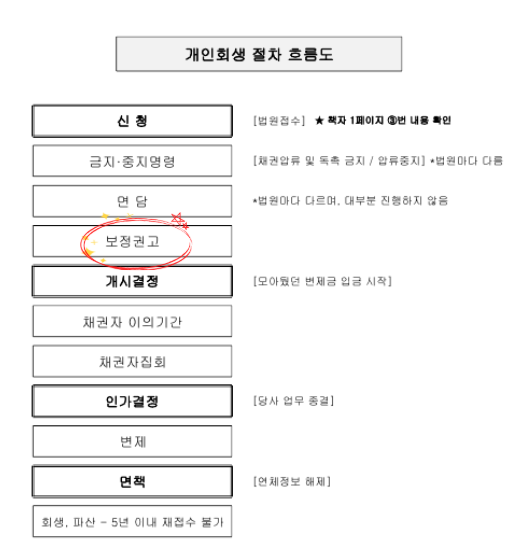
Put simply, it is a process of checking, one by one, where this money was spent, exactly how much your assets are worth and how much you actually earn. You must answer these questions properly to get through the commencement decision to confirmation.
Three things the court checks to the end
Correction requests ask about many things, but in the end they come down to three.
- Is the flow of money clear?
- Have assets been hidden?
- Has there been excessive overspending or squandering?
Once these three are in order, responding to correction requests becomes much easier. The items below all break these three questions down.
Explanation standards by item
The use of recent loans comes first
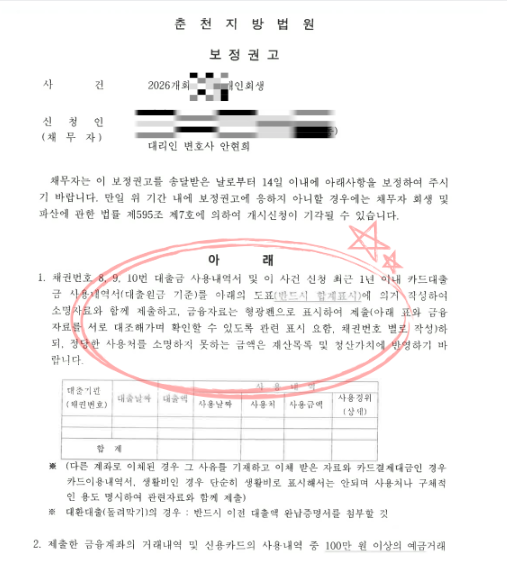
The first thing the court looks at is where loans taken within the last year were spent. Explain specifically, such as paying card bills, hospital bills, living costs or existing loans, and the amounts borrowed and spent must match. Submit evidence such as bank transfer records and card statements along with the explanation.
Accounts and cards are explained amount by amount
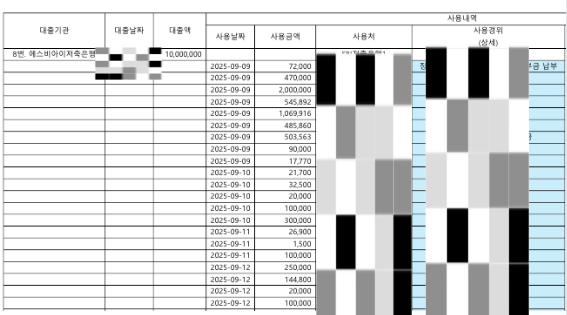
The court does not look only at the account balance. It picks out the large transactions of the last year and asks how the money was used. You must answer specifically for each amount, for example KRW 1 million for hospital bills, KRW 2 million for living costs and KRW 1.5 million for a child's education, and any amount you cannot explain is reflected in the liquidation value.
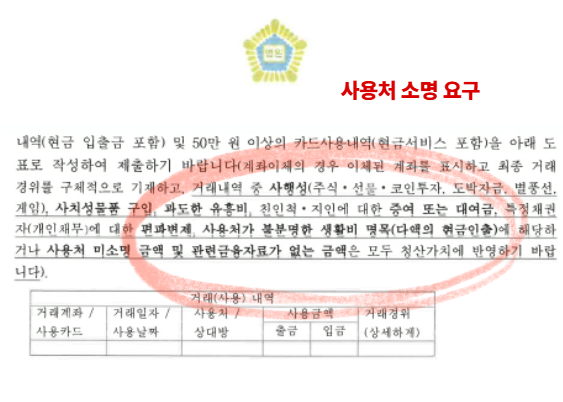
Card use is also reviewed thoroughly, and it is a surprisingly common blind spot. The purpose of payments over KRW 500,000 and of card loans must be stated, and luxury goods, excessive shopping and entertainment expenses are factors that increase the repayment amount.

Liquidation value: money already spent is also treated as an asset
Liquidation value is a concept you must understand in personal rehabilitation. It is the value of your assets plus the amount of problematic spending, and your total repayment cannot be less than this.
If your liquidation value is KRW 7 million, made up of KRW 5 million in deposits and KRW 2 million in shares, you must repay at least KRW 7 million. If you own real estate, part of its value is added too, and money spent on luxuries, gambling and waste is included as well. Money you lost does not simply disappear; it is treated as if it were still an asset.

Income, your spouse's income and overseas travel
The standard the court ultimately applies in personal rehabilitation is the ability to repay. That is why the court looks at your income together with your spouse's income. If your spouse is able to work, the range recognized as dependents may shrink, and this directly affects how much living expenses are allowed.
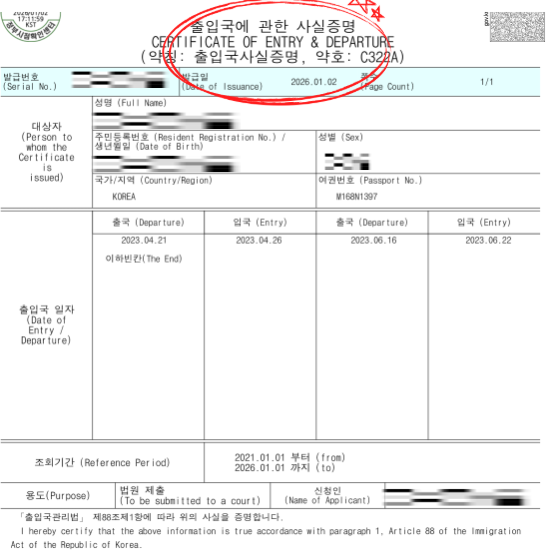
These days, overseas travel and immigration records are also given weight. If there are recent travel records, the court asks where the travel money came from and how it was spent, and travel while in debt can be judged to be luxury spending.

Where people get stuck preparing alone
The reasons people get stuck on correction requests are usually similar: they do not know which part is the problem, they do not know how to explain it, and they are unfamiliar with how to organize the documents. Even with the same circumstances, the court's judgment can differ depending on how the written explanation is drafted.
In the end, a correction request in Wonju personal rehabilitation is a process of giving an explanation that convinces the court. The core of responding is preparing so that the reasoning, the documents and the structure all fit together.
Last reviewed: 2026-10-19 This article provides general legal information; specific advice is given through consultation.
Tell us what is happening first
Leave an inquiry and we will explain how to proceed after reviewing it. If it is urgent, please call 1577-0448.