
Crypto Investment Losses in Personal Rehabilitation: Seoul Bankruptcy Court vs. District Courts
If you are looking into personal rehabilitation because of crypto investment losses, the court with jurisdiction matters as much as your debt and income, perhaps even more. Even for the same crypto investment losses, the Seoul Bankruptcy Court and district courts often calculate liquidation value differently, so the repayment amount and period can differ significantly. Every time the market falls sharply, more people ask about personal rehabilitation (gaein hoesaeng) because of stock and crypto investment losses, so we have set out the differences between courts with examples.

When you file for personal rehabilitation, which court has jurisdiction determines the outcome.
Why the court with jurisdiction decides the outcome
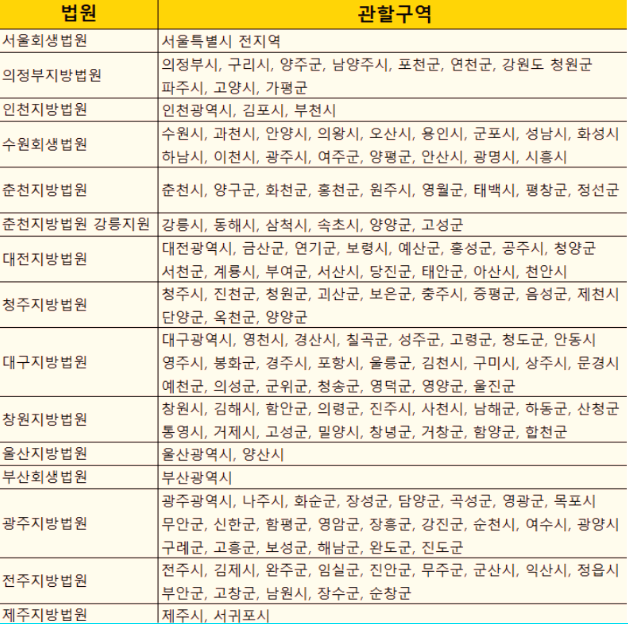
In personal rehabilitation, the result can differ depending on which court handles the case, even under the same conditions. Apart from places with a dedicated bankruptcy court (hoesaeng beobwon), such as the Seoul Bankruptcy Court, the Suwon Bankruptcy Court and the Busan Bankruptcy Court, personal rehabilitation in most regions is handled by the district court.
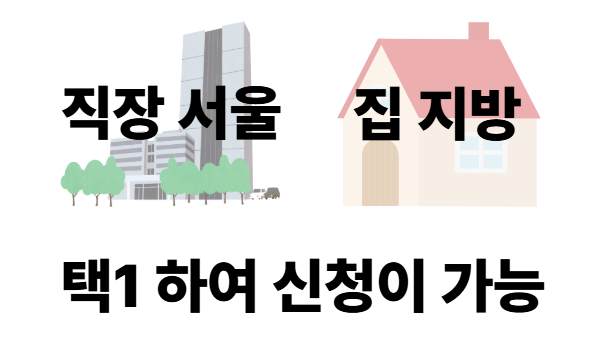
The difference arises from whether crypto and stock investment losses are included in the liquidation value. If the jurisdictions of your residence and your workplace differ, you can choose which court to file with.
The same crypto losses: comparing the calculations of two courts
Take the following situation as an example.
- Total debt of KRW 100 million
- Crypto investment losses of KRW 50 million
- Monthly disposable income of KRW 1 million
Under its practice guidelines, the Seoul Bankruptcy Court often does not include crypto investment losses in the liquidation value. In this example, you would repay KRW 36 million over 36 months, and there is room for the remaining KRW 64 million or so to be discharged.
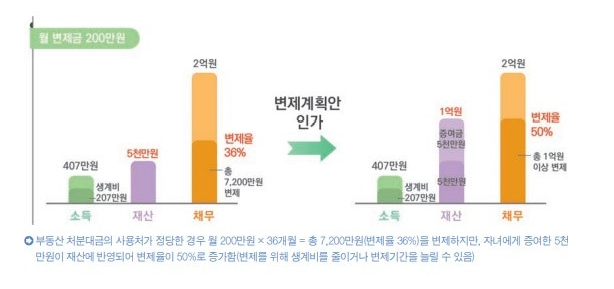
The illustration uses real estate as an example, but crypto is viewed in the same way.
Some district courts often recognize the KRW 50 million in crypto investment losses as liquidation value as it stands. Then, under the principle of guaranteeing liquidation value, you must repay at least KRW 50 million. At KRW 1 million a month that works out to about 50 months, and to fit it into 36 months you would have to pay KRW 1.3 million to KRW 1.4 million every month.
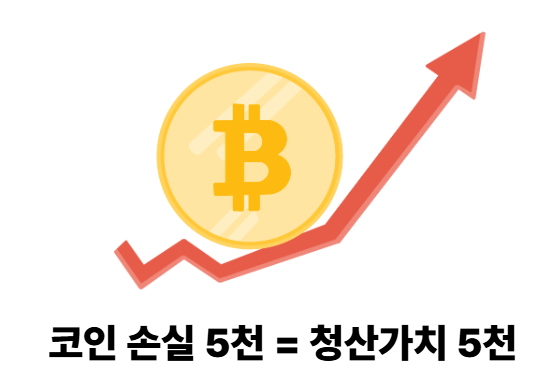
District courts are not always less favorable
Depending on the size of the losses, there may be no difference even at a district court. Let us change the conditions.
- Total debt of KRW 100 million
- Crypto investment losses of KRW 30 million
- Monthly disposable income of KRW 1 million
Paying KRW 1 million a month for 36 months means repaying KRW 36 million. This is more than the KRW 30 million in crypto losses, so the principle of guaranteeing liquidation value is already met. In this case, whether at the Seoul Bankruptcy Court or a district court, you can proceed with 36 months of repayment in the same way.
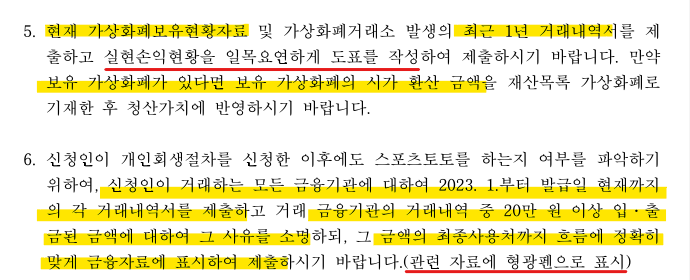
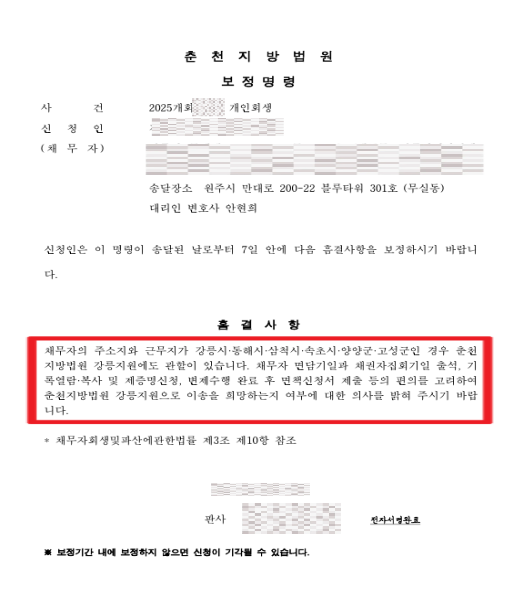
This is an example of a correction order actually issued, asking for liquidation value to be reflected.
The Seoul Bankruptcy Court is also becoming stricter
Even the Seoul Bankruptcy Court does not always exclude losses. These days it may raise issues in the following circumstances.
- Investing with recently obtained loans
- Investing in crypto within three months before filing
- Investing loan money and incurring losses
In such circumstances, a correction may be issued requiring crypto investment losses to be included in the liquidation value. Review is gradually becoming stricter than before.
Three things to check before filing
First, check which court has jurisdiction over you.

Second, examine whether your investment losses will be included in the liquidation value.

Third, look at whether your investments were made recently.
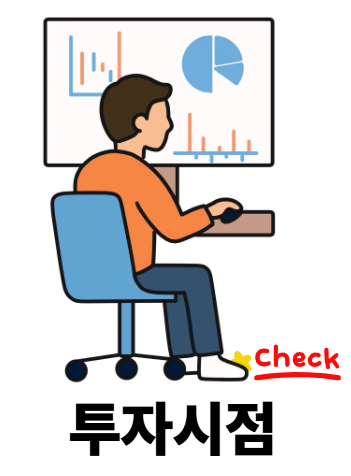
Depending on these three points, the repayment period, the monthly repayment and the amount of debt discharged can differ significantly. If your debt arose from crypto or stock investments, do not judge your chances of personal rehabilitation from the debt amount alone; first check the court with jurisdiction, the timing of your investments and how liquidation value will be assessed.
Last reviewed: 2026-10-19 This article provides general legal information; specific advice is given through consultation.
Tell us what is happening first
Leave an inquiry and we will explain how to proceed after reviewing it. If it is urgent, please call 1577-0448.