
Grounds for Dismissing Personal Rehabilitation: 7 Criteria the Court Reviews
It is easy to assume that anyone who files for personal rehabilitation (gaein hoesaeng) will have a plan confirmed, but the court reviews each case and issues commencement and confirmation decisions only for cases that meet the requirements. The quickest way to find out whether personal rehabilitation will work for you is to check the grounds for dismissal first. We have summarized the seven grounds for dismissal that actually arise in practice and what to do after a dismissal.
1. When debt exceeds the limit
Personal rehabilitation has a cap on total debt. If secured debt exceeds KRW 1.5 billion or unsecured debt exceeds KRW 1 billion, personal rehabilitation cannot be used.

These are typical situations.
- Secured loans exceeding KRW 1.5 billion after buying properties one after another, including gap investments
- Holding several presale rights so that interim payment and balance debts exceed KRW 1 billion
- Debts to business partners piling up beyond KRW 1 billion as a business declines
In these cases, bankruptcy or general rehabilitation, which have no amount limit, are considered instead of personal rehabilitation.
2. When there is no disposable income
Personal rehabilitation presupposes a steady income. The amount left after deducting the living expenses recognized by the court from income is called disposable income, and this amount becomes the monthly repayment. If monthly income is KRW 2 million and living expenses for a one-person household are KRW 1.54 million, the structure is to repay the disposable income of KRW 460,000 every month.
If monthly income is KRW 1.4 million, it does not even reach living expenses, so personal rehabilitation is in principle difficult. However, there have been cases recognized as exceptions where the applicant is older and finds it hard to increase income, or where family members contribute part of the living costs.
For reference, the standard living expenses by household size for 2026 are as follows.
3. When documents are not submitted or are false
This is a very common ground for dismissal in practice.
- Omitting assets or income
- Hiding assets under another person's name
- Failing to submit a correction within the deadline
The court is strict about correction deadlines. If you receive a correction order to submit within 14 days, it is best to prepare with time to spare, because submitting right before the deadline carries the risk of dismissal if documents are missing.
4. When procedural costs are not paid
Personal rehabilitation involves costs such as stamp fees, service fees and the rehabilitation commissioner's fee. Service fees in particular may require additional payments while the case is in progress. Failing to pay on time is also a ground for dismissal, so be careful.

5. When a discharge was received within the past 5 years
If five years have not passed since receiving a personal rehabilitation discharge or a bankruptcy discharge, you cannot in principle apply again. When applying for bankruptcy again, a seven-year limit applies. This rule exists to prevent repeated abuse of the system.

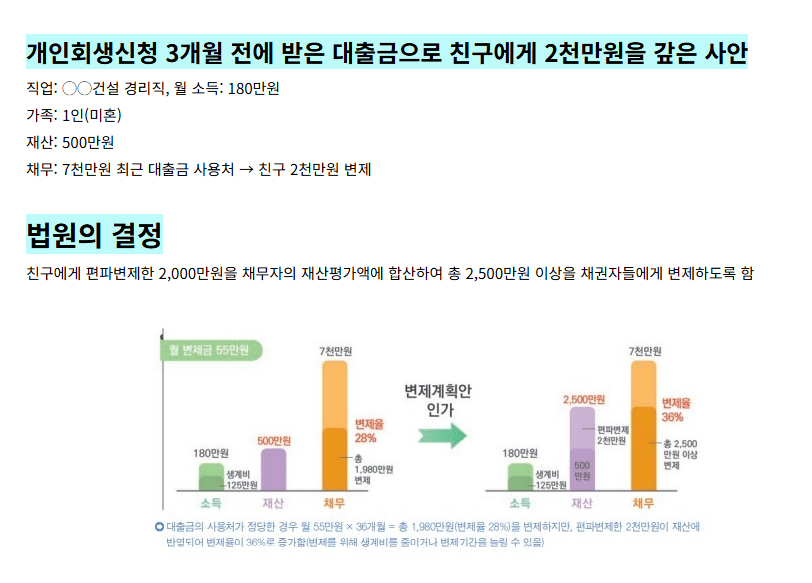
6. When you cannot repay as much as the liquidation value
Personal rehabilitation follows the principle of guaranteeing liquidation value. This means you cannot repay less than the amount that would be obtained if all your assets were disposed of. The following circumstances raise the liquidation value and cause problems.
- Repaying only debts owed to family members right before filing
- Preferential repayment made only to certain creditors
- Selling assets in advance to convert them to cash, or transferring title
If these amounts are added to the liquidation value, repayments can rise significantly, and if you cannot afford them, the case may be dismissed.
7. When the application is not made in good faith
The law also makes an application not made in good faith a ground for dismissal. The court weighs the following circumstances as a whole.
- Deliberately increasing debt sharply right before filing
- Filing immediately after excessive spending
- Moving assets into the name of a spouse or relatives
- Repeatedly filing to stop collection demands
- Failing for a long time to respond to correction requests
What happens after a dismissal?
Receiving a dismissal decision does not close the door. You can file again right away, or appeal and contest it before a higher court.
Note that the prohibition order and the stay order lose effect along with the dismissal. Creditors' demands and collection may resume, so if a dismissal is expected, it is wise to prepare a new filing in advance.
Personal rehabilitation does not proceed simply because you have a lot of debt. The court looks at the amount of debt, income structure, assets and the applicant's good faith together. Insufficient preparation can lead to dismissal, but it is also a procedure you can try again once you know the exact grounds for dismissal and address them. Check the seven criteria above one by one to see where your situation fits.
Last reviewed: 2026-10-19 This article provides general legal information; specific advice is given through consultation.
Tell us what is happening first
Leave an inquiry and we will explain how to proceed after reviewing it. If it is urgent, please call 1577-0448.