
Personal Rehabilitation Repayment Rate Statistics: When 90% of Debt Is Forgiven
The repayment rate is the share of the debt owed that is actually repaid, and the reduction rate is the share of the remainder that is forgiven. The question we hear most often in personal rehabilitation (gaein hoesaeng) consultations is whether a 90% reduction is really possible. The statistics show that it is possible, but only for a very small share of applicants. Based on the Seoul Bankruptcy Court's statistics for the first half of 2025, we looked at trends in personal rehabilitation repayment rates and the conditions under which the reduction becomes larger.

What a median repayment rate of 33.2% means
The median is the value of the person standing exactly in the middle when applicants are lined up in order of repayment rate. A median personal rehabilitation repayment rate of 33.2% in the first half of 2025 means that half of applicants repay more than this and the other half repay less.
Looking year by year, the median has fallen slightly every year. This means the trend toward lower repayment rates is continuing.
Looking at the distribution in the same statistics makes the picture clearer.
- More than 70% of applicants have a repayment rate below 50%.
- About 6.1% of applicants have a repayment rate below 10%, in other words a reduction of more than 90%.
- Conversely, around 7% of applicants have a repayment rate of 90% or more and repay almost everything.
A 90% reduction certainly happens, but the statistics conclude that it is a limited case covering just over 6% of the total.
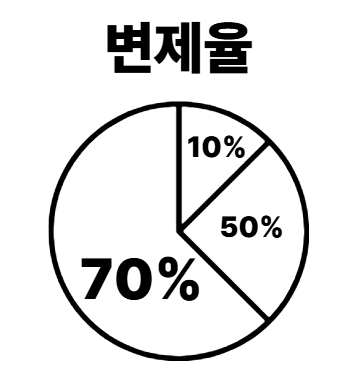
The repayment rate and the reduction rate are numbers that look at the same debt from opposite sides. If the repayment rate is 10%, the reduction rate is 90%, so be careful not to mix up the two terms.
Four conditions that widen the reduction

First, the lower the income
Personal rehabilitation repayments are set as monthly income minus the living expenses recognized by the court. Lower income means smaller repayments, and the reduction grows accordingly.
- Monthly income of KRW 2 million
- Living expenses for a one-person household of KRW 1.54 million
- Monthly repayment of about KRW 460,000
Under the same conditions, if income were KRW 3 million, the repayment would rise sharply. This is why the lower the income, the higher the chance of a reduction of 90% or more.
Second, the more dependents
Even with a certain level of income, the recognized living expenses rise with the number of dependents. With the same monthly income of KRW 3 million, living expenses are set at KRW 1.54 million for a one-person household and KRW 2.52 million for a two-person household, which creates a large difference in repayments.
However, the court also considers the spouse's income and assets and whether the spouse is able to work. If the court finds that the spouse is able to work, it may recognize only part of the dependents.


Third, the fewer assets
In personal rehabilitation, you must repay at least the liquidation value. Simply put, the liquidation value is the value of the assets you currently hold. Most assets are included, such as deposits, savings, real estate, lease deposits, cars, shares, cryptocurrency, business facilities and retirement pay.
If your assets are worth KRW 72 million, you would have to repay more than KRW 2 million every month over 36 months. The more assets you have, the higher the repayment rate and the smaller the reduction.
Fourth, no record of wasteful spending
This condition is often overlooked. Gambling, luxury spending, excessive consumption, preferential repayment made to certain creditors first, and gifts transferred to family members can be added to the liquidation value. Some district courts even reflect losses on shares or cryptocurrency.
If you hold assets of KRW 36 million and lost KRW 36 million gambling, the liquidation value may be calculated as KRW 72 million in total. Even if no money actually remains, the court treats it as remaining and raises the repayment. Applicants are also usually asked to explain in great detail how recent loans were used and how their cards were used.

It is common to be asked to reflect such amounts in the liquidation value at the correction order stage, so it is a good idea to organize these records in advance.
Applying the statistics to your own situation
Putting the statistics together, personal rehabilitation applicants who receive a reduction of more than 90% generally look like this.
- Their income is low.
- They have many dependents or have their dependents recognized.
- They hold almost no assets.
- They have no issues such as luxury spending, gambling or preferential repayment.
The more of these four conditions are met together, the higher the chance of a reduction.

As of 2025, seven out of ten personal rehabilitation applicants repay less than half of their debt. Even so, a reduction of 90% or more remains a limited case of around 6%. Personal rehabilitation is not a system that cuts debt by as much as possible no matter what; it reflects income, assets, dependents and past spending habits together. The first step is to assess objectively which range your situation falls into.
Last reviewed: 2026-10-19 This article provides general legal information; specific advice is given through consultation.
Tell us what is happening first
Leave an inquiry and we will explain how to proceed after reviewing it. If it is urgent, please call 1577-0448.