
Personal Rehabilitation vs Personal Bankruptcy: Why the Court Looks at Rehabilitation First
It is easy to think that personal bankruptcy, where you do not have to repay, must be the most favorable option for a debtor. But bankruptcy is not always the most favorable system. In practice, the court, creditors and legal representatives all far more often consider personal rehabilitation (gaein hoesaeng) before bankruptcy. We have summarized how the two systems differ and why rehabilitation is raised first.
Isn't personal bankruptcy the best? It's the system where you don't repay.

Why the court and creditors look at rehabilitation first
The reason is simple. Personal rehabilitation is a system in which the debtor repays at least part of the debt, while personal bankruptcy is in principle a system in which the debt is not repaid. Rehabilitation is more favorable from the creditors' standpoint, and the court also recommends rehabilitation to debtors who are able to repay.
As a result, more people can in fact resolve their debts through rehabilitation, and when someone with income files for bankruptcy, it is not uncommon for the application to be dismissed or for discharge to be denied.
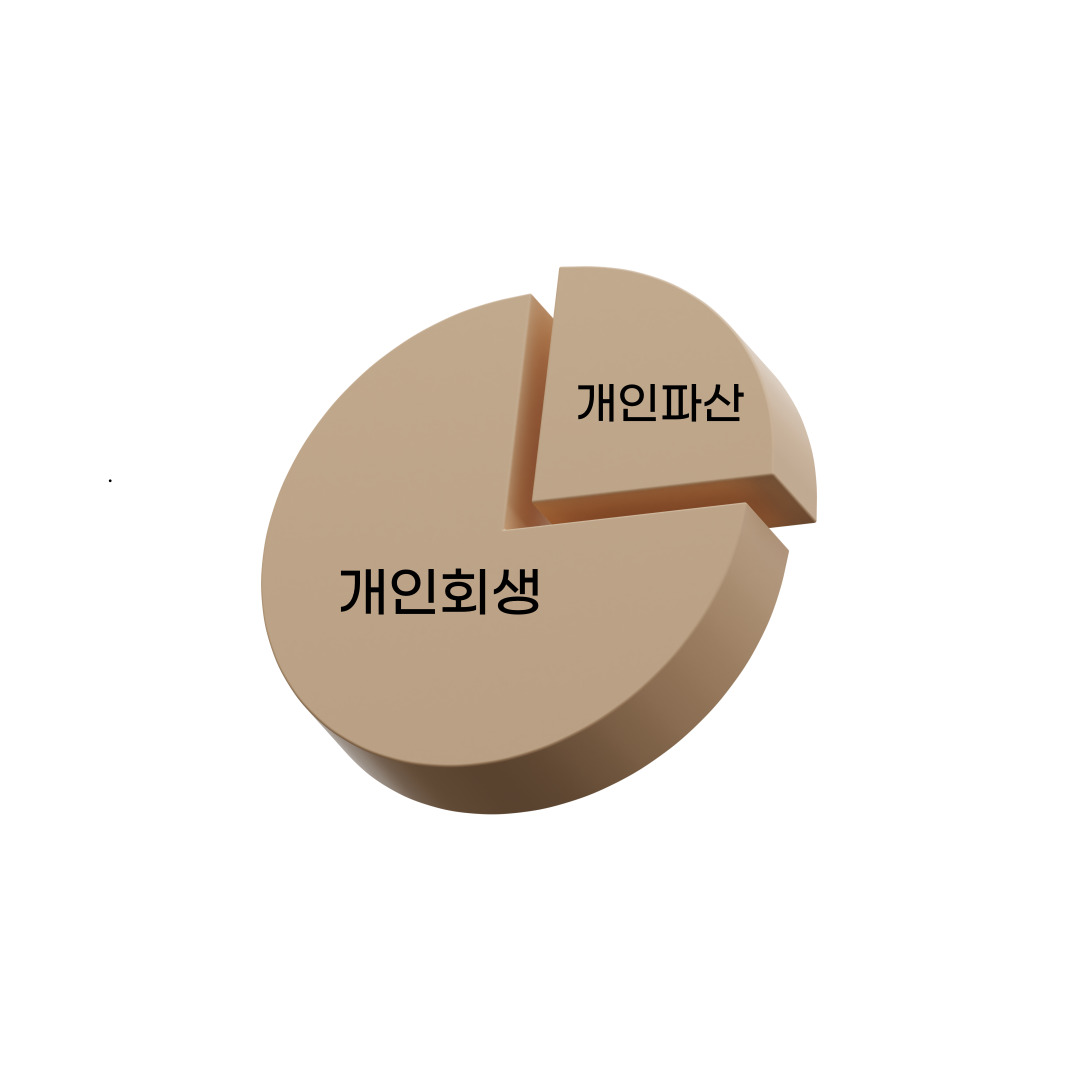

Comparison of personal rehabilitation and personal bankruptcy
Personal rehabilitation is a system for repaying
Personal rehabilitation is a system in which a person with income repays debt from disposable income, after deducting living expenses, over a set period, usually 36 months, and has the remainder discharged.
Here is an example calculation. If monthly income is KRW 2.25 million and living expenses for a one-person household are set at KRW 1.25 million, disposable income is KRW 1 million. Paying KRW 1 million for 36 months means repaying KRW 36 million, and if the debt is KRW 100 million, KRW 64 million is discharged.
However, if speculative debts such as those from gambling, shares or cryptocurrency are mixed in, you may have to repay more through a correction to the liquidation value.
Personal bankruptcy is a system for people who cannot repay
Personal bankruptcy is a system for people who have no income at all, cannot work because of an accident or illness, or are effectively unable to find work because of their age. Once bankruptcy is declared, a bankruptcy trustee is appointed to investigate whether there are grounds for denying discharge, and if there are no assets to dispose of and distribute, the entire debt can be discharged.
Why bankruptcy is not granted easily
If bankruptcy were granted too easily, fewer people would try to repay their debts faithfully. If someone who is fully able to work and has had a steady income suddenly quits their job and files for bankruptcy because they do not want to repay, the application is very likely to be dismissed. The law also makes an application not made in good faith a ground for dismissal.
A bankruptcy declaration is not the end, either. If problems come to light in the later investigation, discharge may be denied, so it is best to let go of the idea that filing for bankruptcy automatically means debt forgiveness.
A bankruptcy trustee's investigation is far more thorough than in rehabilitation
In personal bankruptcy, a bankruptcy trustee is appointed and examines the following.
- Bank transaction records: usually for 5 years, sometimes more than 10 years
- Records of asset disposals
- Money transactions between family members
- Whether any assets have been hidden
The investigation is far more intense than in personal rehabilitation. Many debtors feel great psychological pressure during the interview with the trustee.
When bankruptcy is still needed
In short, if you have income, personal rehabilitation is in principle the right choice, and if you have no income and no prospect of recovery, personal bankruptcy is. However, there are real cases where bankruptcy is needed even with income, or where rehabilitation is actually disadvantageous, so you need to assess this against your own circumstances.
- Personal rehabilitation is a system for repaying, and personal bankruptcy is a system for people who cannot repay.
- A bankruptcy application made simply because you do not want to repay is unlikely to be accepted.
- To avoid dismissal or denial of discharge, it is wise to review your circumstances through a consultation before filing.
Last reviewed: 2026-10-19 This article provides general legal information; specific advice is given through consultation.
Tell us what is happening first
Leave an inquiry and we will explain how to proceed after reviewing it. If it is urgent, please call 1577-0448.